
EAAMO Living Labs Colloquium
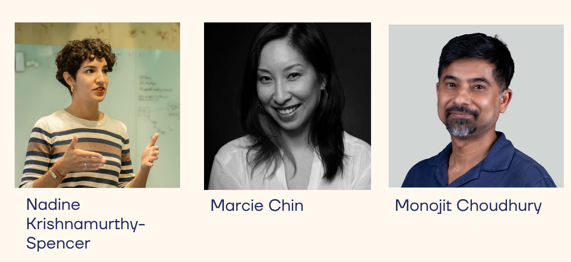
Living Labs with Practitioners explores co-experimentation with social impact practitioners using participatory methods to ask: How can AI systems of care be developed for vulnerable and underserved communities — and what is “safe enough”? Our work bridges generative AI, human–computer interaction, public policy, and the social sciences. This time, we organize a colloquium with Nadine Krishnamurthy-Spencer, Marcie Chin, and Monojit Choudhury with a moderation by Ashley Khor.
To attend the colloquium, register here.
Thursday, May 28, 2026 - 11:00 AM ET
Nadine Krishnamurthy-Spencer is Director of Product and Experience at Chayn, a global nonprofit run by survivors and allies that creates resources and services to support survivors of gender-based violence. Her work focuses on building trauma-informed, multilingual digital services and exploring how technology can support healing rather than harm. At Chayn, she leads product and technology strategy for survivor-facing platforms including Bloom, while advancing approaches centered on safety, privacy, accessibility, power-sharing, and open-source collaboration. Before joining Chayn, Nadine worked across digital product and service design in mental health, customer support, and accessibility-focused contexts.
Marcie Chin is a Language Access Product Delivery Manager at U.S. Digital Response (USDR), where she leads the development of generative AI solutions that improve how governments communicate with members of their community, no matter what language they speak. She specializes in bridging technical innovation with policy and human-centered design to create more effective government services. Marcie believes that thoughtful application of emerging technologies, grounded in deep understanding of people’s needs, can transform how government serves all people.
Dr. Monojit Choudhury is Professor of Natural Language Processing at MBZUAI (Mohamed bin Zayed University of Artificial Intelligence). He is also the chief scientist at the Institute of Agriculture and AI. His research sits at the intersection of language technology and society, with a focus on the learning and (mis)representation of linguistic and cultural diversity by foundation models. He studies how representational disparities shape technology use and linguistic/cultural dynamics in the real world, with the goal of developing fair and equitable language technologies.