
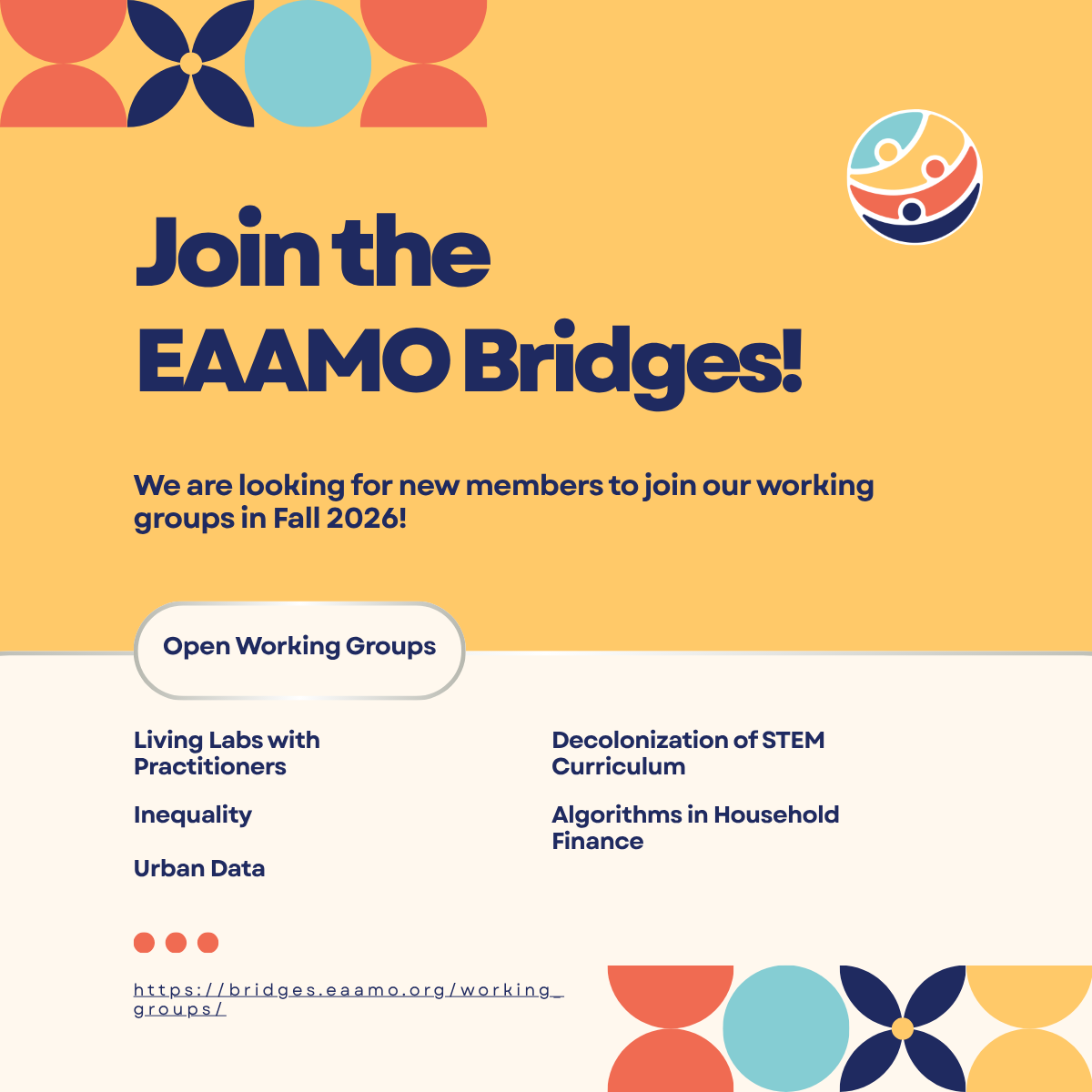
EAAMO Bridges Working Groups are welcoming new members for Fall 2026
The EAAMO Bridges working groups bring together researchers and practitioners to present ongoing work, exchange ideas, and identify opportunities for EAAMO-inspired research to tackle challenges in real-world application domains.
If you would like to join a working group for the first time or switch from your current group, please apply here:
EAAMO Bridges Working Groups Application, Fall 2026
Application deadline: September 4, 2026
ACM EAAMO ’26 Call for Posters
ACM EAAMO ’26 is now accepting submissions for its Work-in-Progress Poster Session.
The poster session welcomes early-stage, ongoing, and recently completed research, as well as practice-driven work relevant to the EAAMO community. Submissions require a title and abstract, while a full paper is optional.
Submission deadline: September 7, 2026 (AoE)
Learn more and submit here:
https://conference.eaamo.org/call_for_posters/
Financial Assistance Applications Open for ACM EAAMO’26
Applications are now open for financial assistance to attend ACM EAAMO’26. As part of its commitment to an inclusive, accessible, and diverse conference, EAAMO is offering support to participants who may otherwise face financial barriers to attending.
ACM EAAMO'26 Call for Participation
We are excited to announce the sixth ACM Conference on Equity and Access in Algorithms, Mechanisms, and Optimization (EAAMO'26), which will take place November 5–7, 2026 at Ludwig-Maximilians-Universität München, Germany.
For full submission details, please visit https://conference.eaamo.org/ .
Abstract Submission Deadline: May 1, 2026 (AoE)
Paper Submission Deadline: May 8, 2026 (AoE)
Paper Submission Page: https://openreview.net/group?id=ACM.org/EAAMO/2026/Conference
Notification: August 1, 2026
Event Dates: November 5–7, 2026

EAAMO Bridges Working Groups: Reflections from Fall 2025
During the second half of 2025, the EAAMO Bridges Working Groups brought together researchers and practitioners to engage with ongoing questions at the intersection of algorithms, markets, and society. Designed as spaces for work in progress rather than finalized results, the groups focused on discussion, experimentation, and shared learning.
A defining feature of the Bridges format was its collaborative ethos. Working groups functioned as intellectual laboratories, places to test early ideas, reflect on failures as well as successes, and learn from others working in adjacent domains.